
ACCESS NL > Features > The A2 exam: your route to permanent residence and Dutch citizenship
The A2 exam: your route to permanent residence and Dutch citizenship
2026/08/12 | By Inburgering.org | Photo by Inburgering.org
If you came to the Netherlands on a work or study permit, you probably don’t have to integrate. There is no three-year deadline and no inburgeringsplicht (integration obligation). But you will still need the exam later. It is what gets you permanent residence or Dutch citizenship — and for you, the level is A2, basic Dutch.
Who must integrate, and who doesn’t
Two groups face very different rules. If you came through asylum, or to join a Dutch partner you usually must integrate (inburgeringsplichtig). Your municipality gives you a plan and a route: the B1 route, the education route (onderwijsroute), or the self-reliance route (Z-route). You get three years, and since 2022 the main target is level B1, not the old A2.
If you came to work — as a knowledge migrant or on an employment contract — to study, or as an EU citizen, you don’t have to integrate. No one sets a deadline. You only need the exam when you decide to stay for good.
Permanent residence and citizenship
After five years living here legally, you can apply for permanent residence, or for Dutch citizenship (naturalisation). Permanent residence lets you live and work here without a sponsor. Citizenship gives you a Dutch passport and the right to vote. Both require you to pass the exam.
When you apply, you must have a residence permit for a non-temporary purpose (niet-tijdelijk verblijfsdoel). A work or knowledge-migrant permit counts; a study permit does not. So students usually switch to a work or partner permit first, and the years they already spent here still count.
For permanent residence and citizenship you need the inburgeringsdiploma (civic integration diploma) at A2. It usually takes from six to twelve months to get your citizenship. If you have been married to a Dutch national for three years, you can apply sooner. Which level you need depends on your permit: the obliged group aims for B1, while applying for permanent residence or citizenship yourself asks only for A2.
What the A2 exam includes
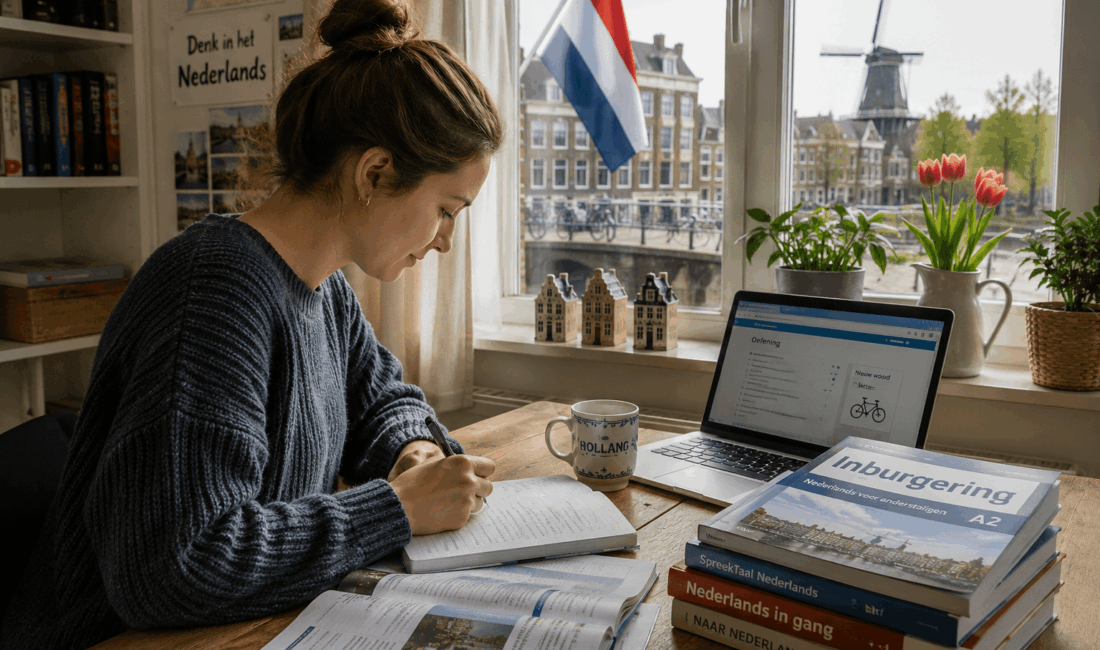
DUO runs the exam on a computer, at exam centres in Amsterdam, Eindhoven, Rijswijk, Rotterdam, Utrecht and Zwolle. It has six parts: four language skills — reading, listening, writing and speaking — and two knowledge tests, KNM (Kennis van de Nederlandse Maatschappij, knowledge of Dutch society) and ONA (Oriëntatie op de Nederlandse Arbeidsmarkt, orientation on the labour market). KNM covers everyday life here — work, healthcare, housing. ONA is about finding and applying for a job. You take and pay for each part separately.
A2 is the basic user level: you handle everyday situations, write short messages, and answer simple questions about yourself. You don’t need fluent Dutch. In the speaking test, you answer short prompts after a beep — one or two clear sentences score better than silence. If you need a higher level for study or skilled work, you take the Staatsexamen NT2 at B1 or B2 instead.
How to prepare
Most people taking this exam already work or study full-time, so you study in your own time. Inburgering.org copies the real DUO format for every part — speaking, writing, listening, reading, KNM and ONA — at A1, A2, B1 and B2, so practice and grading match the real test. You can take full mock exams, download free PDF summaries and sample exercises, and learn words through free language games. If you get stuck, ask a teacher for free. You can read inburgering.org’s blog if you need more information about the exam. More than 1,137 learners have used the site and rated it 4.7 out of 5. Start your preparation today. For the A2 exam, go to inburgering.org A2; if you must reach B1, go to inburgering.org B1. To check which exam you need, start at inburgering.org.
The levels and rules here are correct as of June 2026. DUO and the IND set the official requirements, so check your own case with them before you register.
For information about learning Dutch in The Netherlands, also visit Learning Dutch – ACCESS NL.


