
ACCESS NL > Features > Finding Myself Through Cultures
Finding Myself Through Cultures
2026/02/18 | By Sarai Velez Ramirez
Belonging is usually defined as being part of something — a group, a category, a collective you’re meant to fit into. But what happens when you don’t fully belong to any group? When shared nationality doesn’t create closeness, when language doesn’t guarantee familiarity, or when cultural stereotypes don’t hold you?
As a Mexican who lived in India and now lives in the Netherlands, the traditional meaning of ‘belonging’ no longer works — because I don’t neatly fit into the groups I’m supposed to belong to.
And that is where my story begins.
I was born in Mexico City. I love my country — the language, the food, the traditions. And yet, from early on, I felt slightly off. I was too direct, too literal, uneasy with what was implied rather than spoken. Much of Mexican culture never quite landed for me — telenovelas, tequila, traditional dress, even the shared references everyone else seemed to know by heart. It often felt like everyone had received a manual I had somehow missed.
Over time, that difference stopped feeling like personality and started feeling like failure — as if I wasn’t ‘enough’ Mexican. I didn’t fully fit the shape I was meant to.
Not long after, life shifted.
I met my husband, an Indian Sikh, and in 2016 we began our married life in India. I didn’t know it then, but that move would quietly reshape my understanding of home and of myself. India didn’t meet me gently. Nothing could be done on autopilot; even small decisions carried weight. One of the quietest shifts happened around food — not emotionally, but practically. Finding ingredients to cook Mexican food was difficult and unsustainable, and letting go of it was easier than I expected. I adapted. I learned to cook Indian food, guided by my mother-in-law. Even now, Indian food fills our table most days, with a few Mexican and continental dishes woven in.
As I was learning how to live in India, I also tried to carry Mexico with me. I held on to my traditions as a way of staying rooted. We celebrated Independence Day, Day of the Dead, Three Kings’ Day, and Candlemas. These rituals became anchors in a life that otherwise required constant adjustment. I even started a small business selling traditional foods to the Mexican and Latin community and later began making piñatas. Creating them felt less like remembering who I was, and more like living it. For a while, I believed that would be enough. But slowly, something else became clear.
In India, despite my efforts to stay connected to my roots, I never truly felt close to the Mexican or Latin community. There was no conflict — just a lack of resonance. Familiarity did not translate into belonging. Instead, the spaces where I felt safest were with other internationals living there. They became my chosen family. People with whom I didn’t feel watched, measured, or expected to be anything other than myself.
At the same time, Indian traditions were already woven into my daily life. Lohri, Holi, Vaisakhi, Diwali, Gurpurab — they shaped my calendar, my seasons, my sense of time. I also loved wearing Indian clothes. Kurtas, sarees, lehengas — they never felt symbolic or performative but natural, in a way I still can’t fully explain. It didn’t feel like adapting. It felt like I was myself, simply expressed differently.
By the time we left India in 2022, after my husband received a job opportunity in the Netherlands, I was no longer the person who had arrived. India had shaped me quietly and deeply. So, when we moved to the Netherlands, I carried a quiet assumption with me. In India, my closest connections had been international rather than local, and I expected that pattern to continue. But living here revealed something I hadn’t anticipated.
Despite the wide variety of international communities in the Netherlands, the shared language, background, and experiences didn’t automatically create closeness. And without effort or intention, I found myself feeling at ease within the Indian community here. That realisation surprised me. Quietly, it clarified something I hadn’t been able to name before. I missed India — not as a place I had once lived, but as home. And in recognising that, I understood that Mexico no longer felt like home.
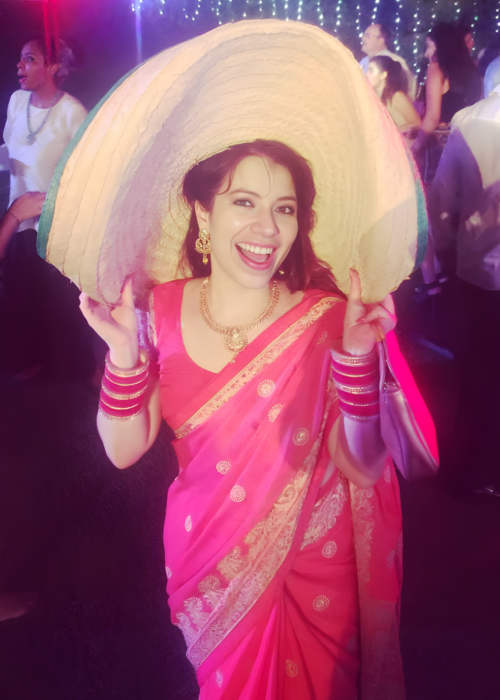
Despite the wide variety of international communities in the Netherlands, the shared language, background, and experiences didn’t automatically create closeness. And without effort or intention, I found myself feeling at ease within the Indian community here. That realisation surprised me. Quietly, it clarified something I hadn’t been able to name before. I missed India — not as a place I had once lived, but as home. And in recognising that, I understood that Mexico no longer felt like home.
The Netherlands became another layer. I adapted again — not by replacing what I carried, but by letting it expand. Mexican traditions remained. Indian ones continued. Dutch rituals found their place. My calendar became layered, not divided. New Year’s Eve now holds all of it: the twelve Mexican grapes, time at the gurdwara (Sikh temple) and oliebollen. Nothing competes. Nothing needs to be chosen. This is my normal.
Some people are surprised that a Mexican woman feels most at home within an Indian community. But for me, it makes complete sense. This is what immigration teaches you, if you let it. Belonging is not about origin or category. It’s about alignment — with the places, rhythms, and communities where you can exist fully, without explanation.
Today, I live in the Netherlands.
My heart lives in India.
And I am Mexican.
None of these cancel each other out. Together, they make me whole.
ACCESS Stories is a monthly newsletter with the heartfelt intent to help you make the most of your new lives in the Lowlands. Visit our Features page to explore all published stories.


